
SELMA MEERBAUM-EISINGER
“I want to hold sky in my hands
I want to be free and breathe and scream.”
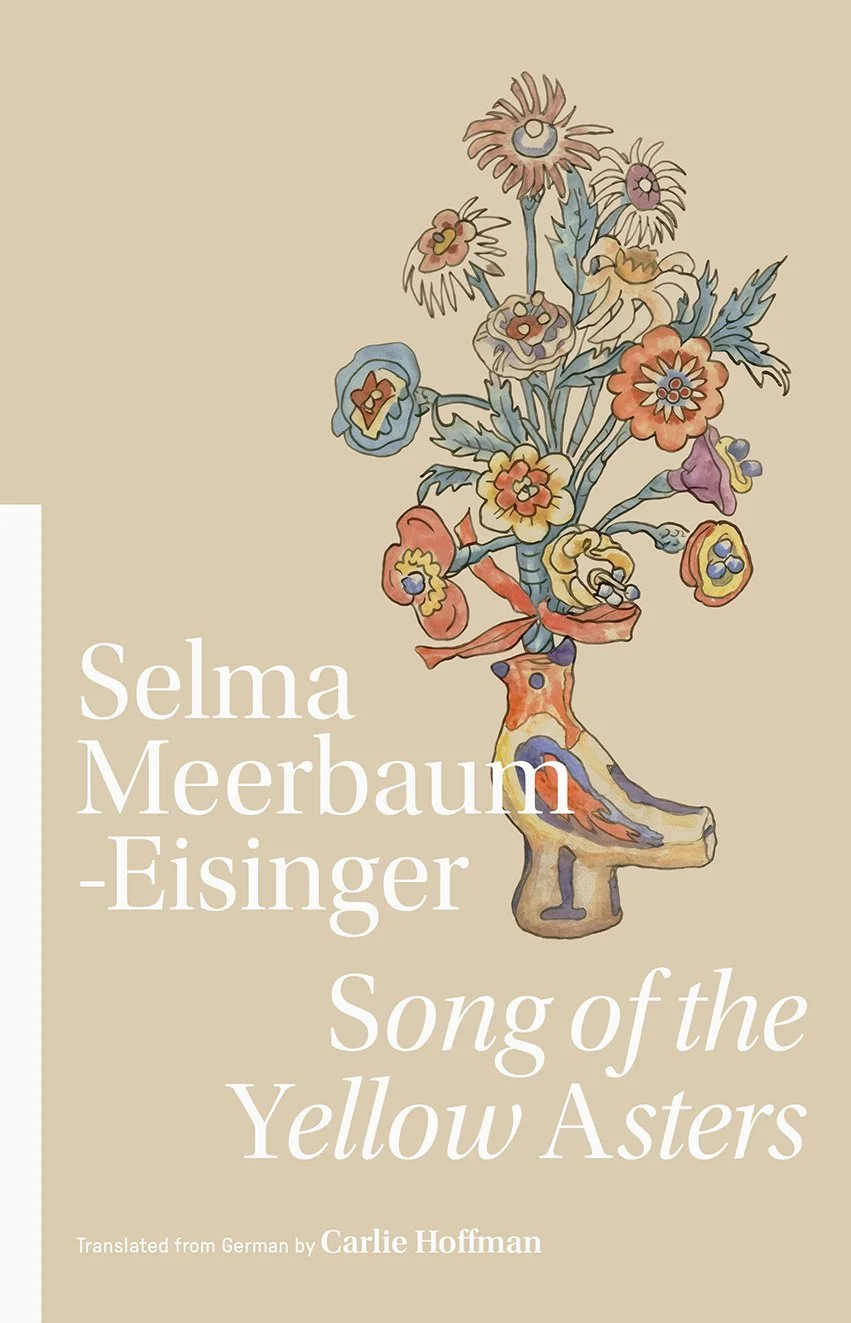
My translation of Selma Meerbaum-Eisinger’s Song of the Yellow Asters is forthcoming from World Poetry Books in March 2026.
The life of Selma Meerbaum-Eisinger, a cousin of Paul Celan, was cut short in a Nazi labor camp, but her poems survived to bear witness with lyric tenderness, resilience, and enduring humanity.
Meerbaum-Eisinger collected her poems—alongside translations from French, Yiddish, and Romanian—written between the ages of 15 and 17, in a meticulously crafted handbound volume titled Blütenlese. Drawing on a rich folkloric and literary lineage from Verlaine to Rilke to Tagore, these 57 poems explore love, nature, and the human spirit under occupation and amid the Holocaust. Carlie Hoffman's new English translation returns Meerbaum-Eisinger to her rightful place among twentieth-century Eastern European poets who offered a living song of remembrance to the horrors of their era.
PRAISE FOR SONG OF THE YELLOW ASTERS
“In the amber of her own alertness, Carlie Hoffman has caught Selma Meerbaum-Eisinger’s most striking gift—her ability to register the nearly invisible dramas and precarity of just about everything she encounters. From the opening “Song” to the closing “Tragedy,” Hoffman’s subtle melodic throughline holds the imagery of the precocious young poet’s inner and surrounding landscapes in resonant constellation. A remarkable body of rescued work.” —Peter Cole
“This beautiful new English translation grants the young poet Selma Meerbaum-Eisinger the full range of a lyrical voice that was tragically cut short in the camps of Transnistria in 1942. Love and longing, vulnerability and hope merge in these tender, intimate poems that yearn to affirm life and refuse despair.” —Marianne Hirsch
“Song of the Yellow Asters, Carlie Hoffman’s new translation of Selma Meerbaum-Eisinger’s poems should make Meerbaum-Eisinger a significant figure in not only Holocaust literature, but poetry in general. Meerbaum-Eisinger is all about possibility and potential, cut-off by the abyss of fascism when she was only 18. Hoffman’s translation sounds contemporary: it’s muscular and textured. The speakers’ internal colors transform into weather, floral and vegetable settings, and an emotional core smoldering with intention. It’s poetry of a young person pulsing with dormant energy, surrounded by danger, but possessed with a chiseled clarity.” —Sean Singer
“I so love Selma Meerbaum-Eisinger’s buoyant spirit, her determination to sing a joyful song in the face of destruction, her own doom, the impending murder of the people she loved, and Carlie Hoffman has given us a literary gift by bringing these German-language poems into English with so much verve, sensitivity, learning, and dedication. It is agonizing to think of a life cut so painfully short, and yet these vibrant poems by a preternaturally talented teenager fill me with jubilation at the way that poetry can inspirit us, singing our lives and lifting our hearts.” —Edward Hirsch
“Despite the unimaginable suffering Selma Meerbaum-Eisinger endured, this young Jewish poet assembled a manuscript full of unforgettable and deeply-felt imagistic poems that bear witness, with a loving and intimate intelligence and sensibility, to a devastating period of history. Carlie Hoffman's translation is a tremendous gift, awakening readers to the profound amplitude of Meerbaum-Eisinger’s spirit.” —Yerra Sugarman
“This is poetry one reads with tears of excitement: so pure, so beautiful, so radiant, and yet so imperiled.” —Hilde Domin
SELECTED ONLINE PUBLICATIONS






Quisque iaculis facilisis lacinia. Mauris euismod pellentesque tellus sit amet mollis.